Our science
Free minds from bleeding damage.
RNA-based hemostatic rebalancing therapies for hemophilia and rare bleeding disorders.

Our scientific vision
Despite major therapeutic advances, many patients remain vulnerable to bleeding episodes, progressive joint damage, and lifelong treatment burden.
BLEEDnFIRE is building a therapeutic platform based on a central concept: bleeding disorders can be treated by restoring the balance to the hemostatic system rather than correcting individual disease-specific defects one at a time.
Our lead asset, BnF-001, is designed to become a potential first-in-class protein S-targeting siRNA therapy for patients with hemophilia and other rare bleeding disorders.
By combining hemostatic rebalancing, RNA-based precision targeting, long-acting subcutaneous delivery, and the potential to protect joint and bone health, BLEEDnFIRE aims to redefine prophylactic treatment approaches and improve long-term outcomes for patients living with bleeding disorders.

Rebalancing hemostasis at its source
Instead of replacing an individual missing or defective hemostatic component, we selectively reduce a natural anticoagulant pathway to enhance endogenous thrombin generation and improve overall hemostatic function.
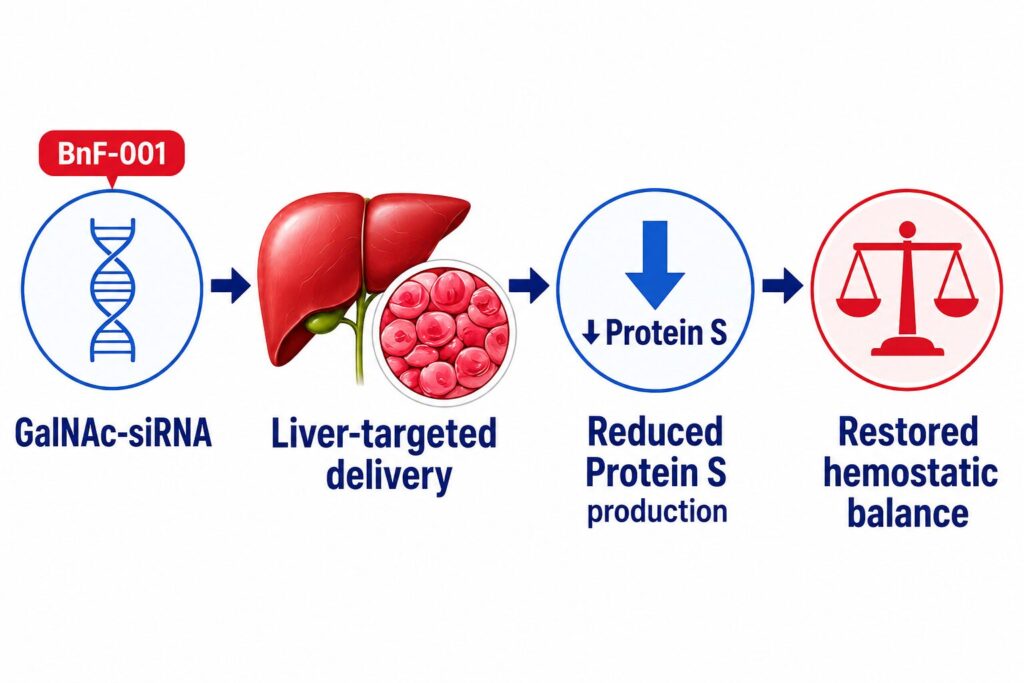
Our lead program, BnF-001, is a GalNAc-conjugated siRNA designed to selectively silence PROS1, the gene encoding protein S, in hepatocytes. By lowering circulating protein S levels in a controlled manner, BnF-001 aims to rebalance coagulation and promote more effective and stable hemostasis.
Why protein S?
Protein S is a key natural anticoagulant that plays a central role in regulating thrombin generation and maintaining hemostatic balance. In healthy individuals, this pathway helps prevent excessive clotting and ensures controlled coagulation responses.
BLEEDnFIRE’s scientific rational is based on the concept that a partial and controlled reduction of protein S can enhance endogenous thrombin generation and thereby strengthen hemostatic capacity. Increased thrombin generation may not only strengthen fibrin clot formation, but also helps compensate for platelet dysfunction by promoting platelet activation and stabilization of the hemostatic plug.
As a central regulator of coagulation, protein S represents an attractive therapeutic target for a broad range of bleeding disorders though a shared, factor-independent mechanism.
Scientific foundation
Blood | 2009
Generation and phenotypic analysis of protein S-deficient mice
Foundational work establishing the role of Protein S in coagulation biology and thrombin generation.
Saller F. et al. (senior author: Anne Angelillo-Scherrer)
Blood | 2020
Platelet protein S limits venous but not arterial thrombosis propensity by controlling coagulation in the thrombus
Demonstrated that platelet-derived Protein S contributes to the regulation of venous thrombosis and hemostatic balance.
Calzavarini S. et al. (senior author: Anne Angelillo-Scherrer)
JTH | 2025
Enhancing hemostasis potency in hemophilia with a small interfering RNA targeting protein S
Demonstrated that siRNA-mediated Protein S targeting can enhance thrombin generation and hemostasis in hemophilia.
Prince Eladnani R. et al. (senior author: Anne Angelillo-Scherrer)
JTH | 2025
Protein S as a therapeutic target
Review article summarizing Protein S biology and its therapeutic potential across thrombosis and bleeding disorders.
Prince Eladnani R. et al. (senior author: Anne Angelillo-Scherrer)
BnF-001: a GalNAc-siRNA designed for controlled protein S modulation
BnF-001 is a liver-targeted, subcutaneously administered GalNAc-siRNA designed to selectively reduce protein S expression in hepatocytes, the primary source of circulating protein S. By lowering PROS1 mRNA expression, BnF-001 is designed to enhance endogenous thrombin generation and support hemostatic rebalancing.
This therapeutic approach is intended to:
- enable controlled hemostatic rebalancing through partial protein S modulation;
- support long-acting subcutaneous prophylaxis with durable target knockdown;
- offer broad applicability across bleeding disorders
One mechanism.
Multiple bleeding disorders.
Many inherited bleeding disorders share a common downstream problem: insufficient thrombin generation and/or impaired formation of a stable fibrin clot.
By modulating protein S, BLEEDnFIRE aims to enhance thrombin generation through a shared, factor-independent mechanism.
Preclinical and ex vivo studies suggest that protein S modulation can improve thrombin generation across multiple bleeding disorder settings, supporting the potential for a broad therapeutic approach across inherited bleeding disorders.
Beyond bleeding control: protecting joints and bones
In severe bleeding disorders, recurrent joint bleeding can drive chronic inflammation, cartilage damage, bone deterioration, pain, reduced mobility, and progressive arthropathy.
While current therapies primarily focus on reducing bleed frequency, preservation of joint and bone health remains a major unmet medical need.
BLEEDnFIRE is investigating protein S modulation not only to improve hemostasis, but also to reduce bleeding-associated joint damage and preserve musculoskeletal health.
Preclinical studies suggest that controlled protein S modulation may reduce hemarthrosis-associated inflammation while helping preserve joint and bone structure, supporting the broader vision of BnF-001 beyond bleed prevention alone.

Preclinical validation

In vivo hemostasis and joint protection
In preclinical hemophilia models, controlled protein S reduction improved hemostatic function and reduced manifestations of joint bleeding and arthropathy. In murine joint bleeding models, protein S modulation was associated with reduced inflammation, decreased joint swelling, and preservation of joint and bone structure.

Non-human primate validation
Studies in non-human primates demonstrated successful target engagement following subcutaneous administration of protein S siRNA, with reproducible reduction in circulating protein S levels. Peak protein S lowering was observed approximately 13 days after dosing, with no thrombosis-related safety signals observed to date at the exposure levels evaluated.

Patient-derived ex vivo evidence
Patient-derived ex vivo studies support the potential broad applicability of protein S modulation across inherited bleeding disorders. Enhanced thrombin generation was observed in samples from patients with hemophilia A and B, von Willebrand disease, Glanzmann thrombasthenia, factor XI deficiency, and other rare bleeding disorders.
A differentiated therapeutic profile

First-in-class Protein S siRNA
Factor-independent rebalancing

Hepatocyte-targeted RNAi
GalNAc-siRNA delivery

Monitorable pharmacodynamics
Plasma protein S biomarker

Controlled target modulation
Designed as a “dial, not switch”

Long-acting SC administration
Potential extended dosing

Joint & bone protection potential
Beyond bleed reduction alone